RAG System Development Service
Generic AI gives generic — and often wrong — answers. Business Gamer's RAG system development service connects your LLM to your company's real data, so every response is accurate, current, and grounded in facts your business can trust. Whether you need custom architecture design or full-scale RAG system development with LangChain, we follow a proven RAG framework so every project moves through discovery, design, and deployment predictably — not as a one-off experiment.
How RAG Works
Real-time retrieval → grounded answers
What is a RAG System (Retrieval-Augmented Generation)?
RAG (Retrieval-Augmented Generation) is an AI architecture that connects a large language model to your organization’s own documents, databases, and knowledge bases. Instead of relying on what the model learned during training, a RAG system retrieves the most relevant information at query time and uses it as context before generating a response — producing answers that are accurate, current, and traceable to specific sources.
In short: RAG = Your Data + Vector Search + LLM = Grounded, source-cited AI answers with zero hallucinations.
Why choose us as your RAG software development service partner?
Grounded, Accurate Answers
No more AI hallucinations pulled from thin air — every answer is retrieved from your actual data before the LLM responds.
Always Up to Date
Your knowledge base refreshes without retraining the model — new documents are searchable in minutes, not months.
Source Attribution Built In
Every answer can point back to the exact document it came from — full transparency for your team and your users.
Enterprise-Grade Security
Role-based access, encryption at rest and in transit, PII filtering, and compliance-ready design from day one.
Faster Time to Value
Proof-of-concept in weeks, not months — we scope and move quickly so you see results before committing to full scale.
Proven RAG Framework
We follow a tested RAG system development framework refined across real client engagements — nothing left to guesswork.
RAG System: Live Example
Here is exactly what happens when a user asks a question — from query to grounded, source-cited answer.
How Enterprise RAG Systems Work
Retrieval-Augmented Generation (RAG) is an AI architecture that connects a large language model to your organization's own data — documents, databases, CRMs, wikis, and APIs — so it retrieves the right information before generating an answer, instead of relying only on what it learned during training. How does RAG eliminate AI hallucinations? By grounding every single response in verified document chunks retrieved in real time.
The result: an AI assistant that answers your questions with your data, accurately and transparently with verifiable source citations. How does semantic retrieval work? Incoming user queries are converted into high-dimensional vector embeddings, matched against indexed knowledge bases, and fed to the LLM with exact context.
Every project starts with mapping out the right RAG system architecture for your data volume, security requirements, and business use case before a single line of code is written.
RAG Architecture Diagram
User Query
Embedding Model
Vector Database
Context Assembly
LLM Generation
Cited Answer
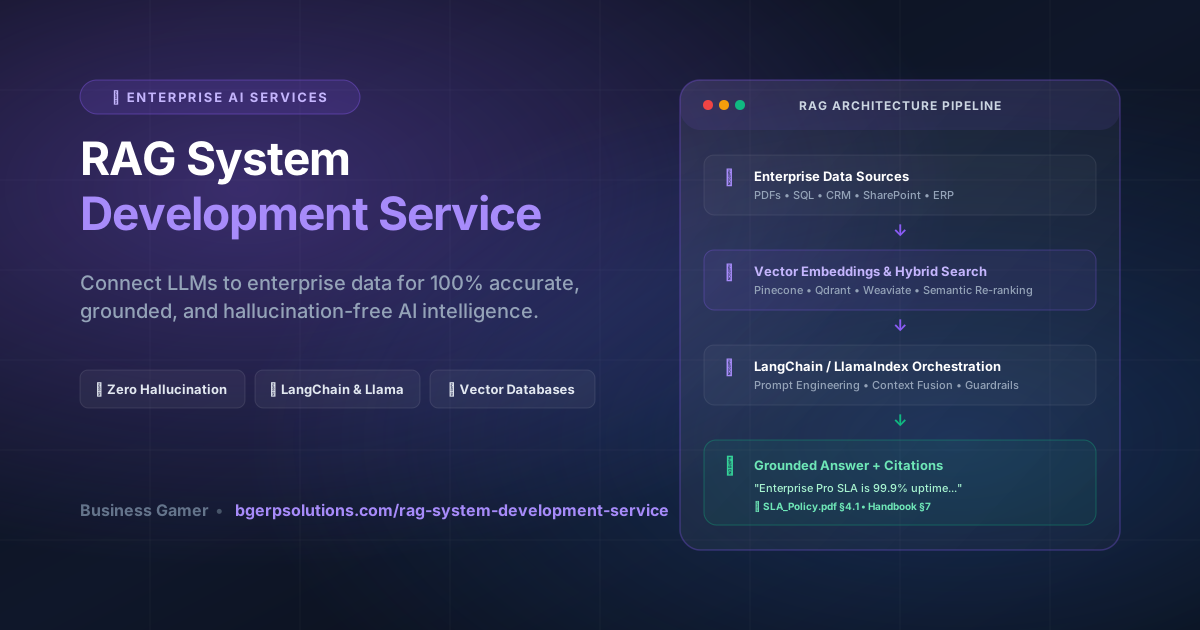
From Your Data Sources to Grounded Answers
RAG connects every data source your business already has — directly into the AI response pipeline. Wondering how to connect unstructured PDFs, databases, and ERPs to LLMs? Our data pipeline chunks, embeds, and indexes your files so they become instantly searchable by AI.
PDFs & Docs
CRM / ERP
Emails & Tickets
SharePoint / Confluence
Databases
APIs & Web
Embedding & Indexing
Vector Database
Semantic Retrieval
“Enterprise Pro SLA is 99.9% uptime with 4h P1 response...”
Our RAG System Development Services
End-to-end RAG development — from strategy and architecture to production deployment and ongoing optimization. Looking for how to build a scalable enterprise RAG pipeline, implement hybrid keyword-semantic search, or deploy agentic workflows? We cover every phase of RAG software engineering.
RAG Architecture & Strategy
We design the end-to-end blueprint for your RAG system architecture — data flow, chunking strategy, retrieval method, and LLM orchestration — tailored to your data and use case. Every engagement includes a clear RAG architecture diagram so your team understands exactly how data moves through the system.
Knowledge Base Construction
We turn your unstructured data — documents, PDFs, wikis, emails, SharePoint, Confluence — into a clean, semantically indexed, AI-ready knowledge base.
Vector Database Architecture
We select and configure the right vector database for your scale — Pinecone, Weaviate, Qdrant, Milvus, or pgvector — with optimized indexing for fast, accurate retrieval.
Hybrid & Semantic Retrieval
We implement retrieval that understands meaning, not just keywords — combining dense vector search with keyword matching for higher precision, plus re-ranking for the best possible context.
LLM Integration & Prompt Engineering
We connect your chosen LLM (OpenAI, Claude, Gemini, or open-source models) to the retrieval pipeline and engineer prompts that produce reliable, on-brand responses. We specialize in production-grade RAG system development with LangChain and LlamaIndex for seamless model orchestration.
Agentic RAG Systems
For complex workflows, we build autonomous RAG agents that plan multi-step retrieval, call external tools and APIs, and reason across multiple data sources before answering.
Multimodal RAG
Need answers from more than text? We build RAG pipelines that retrieve from PDFs, tables, charts, and images — not just plain documents.
RAG Evaluation & Optimization
We continuously measure faithfulness, relevance, precision, and recall — fine-tuning your system so accuracy improves over time instead of drifting.
RAG Security & Compliance
Role-based access control, PII filtering, audit trails, and data privacy safeguards — built in from day one, not bolted on later.
Our RAG Development Process
Every engagement follows the same tested RAG system development framework — so nothing is left to guesswork.
Discovery & Assessment
We audit your data sources, use cases, and infrastructure to define the right RAG strategy.
Architecture Design
We design the RAG system architecture, choose the vector database, and document it as a clear RAG architecture diagram for your team.
Data Pipeline & Indexing
We ingest, chunk, and embed your data into a searchable knowledge base optimized for retrieval accuracy.
LLM Integration & Orchestration
We connect the retrieval layer to your LLM using proven tools for RAG system development with LangChain and engineer custom prompts for accurate, on-brand output.
Testing & Evaluation
We test for accuracy, hallucination rate, latency, and security before go-live.
Deployment & Monitoring
We launch your RAG system with dashboards to track performance and catch issues early.
Continuous Optimization
We refine retrieval quality and expand the knowledge base as your data grows.
RAG vs Fine-Tuning: Which Do You Need?
Not sure which approach fits your use case? Here's a clear side-by-side breakdown.
| Factor | ✅ RAG (Recommended) | Fine-Tuning |
|---|---|---|
| Data Freshness | Real-time Pulls current data at query time | Static Frozen until retrained |
| Cost | Lower No GPU retraining required | Higher Expensive GPU training cycles |
| Hallucination Control | Strong Grounded in retrieved documents | Moderate Can still hallucinate |
| Transparency | High Cites exact source documents | Low No clear attribution |
| Update Speed | Instant Refresh knowledge base anytime | Slow Full retraining cycle needed |
| Best For | ✓ Dynamic knowledge, Q&A, support, search | — Style/tone adaptation, domain reasoning |
Wondering whether to choose RAG or fine-tuning for your enterprise? RAG is ideal for dynamic knowledge bases, internal Q&A, and customer support where data changes frequently and source transparency is required. Our team evaluates your data velocity, accuracy tolerance, and budget to recommend the right strategy.
Where RAG Fits in Your Business
Curious what a real RAG system looks like in practice? Here are common RAG examples we build for clients.
Internal Knowledge Assistants
Instant, accurate answers from your HR policies, SOPs, and internal wikis — no more digging through folders.
Customer Support Automation
Chatbots that answer from your actual product docs and past tickets, with source links for full transparency.
Sales & CRM Copilots
Reps get instant answers pulled from CRM data, proposals, and case studies — right when they need them.
Legal & Compliance Tools
Answers grounded in the latest contracts, policies, and regulations — always current, always citable.
E-commerce Search
Product discovery grounded in live catalog and inventory data — smarter search that converts.
Research & Analysis
Synthesize insights from large document libraries, reports, and datasets with full source attribution.
Want to see how this could apply to your own data? Book a free consultation and we'll walk through relevant RAG examples from businesses like yours.
Book a Free Consultation →See RAG in Action Across Industries
Click any industry to see a real conversation example — with source attribution built in.
For integration setup, the full webhook reference is in our developer docs under “Event Subscriptions.”
Note: This clause was amended in the June 2023 addendum — please verify against the signed addendum for the current cap.
Bonus payouts are processed in the first payroll of February.
1. Data residency — concerned about PHI leaving their region. Response used: We offered a dedicated on-premise deployment option (referenced Case Study: MedCore).
2. Integration with Epic EHR — worried about API compatibility. Response: Demonstrated our pre-built Epic connector and shared the MedCore integration doc.
3. Pricing vs. competitor X — felt our Pro plan was 15% higher. Response: Highlighted 3-year TCO analysis showing 28% lower total cost.
Recommend leading with the MedCore case study again — it was the strongest trust signal.
Technologies We Work With
Best-in-class tools across the RAG stack — cloud-native, open-source, and enterprise-ready. How do we choose between vector databases like Pinecone, Weaviate, Qdrant, and pgvector? We benchmark query latency, indexing speed, hybrid search capabilities, and hosting costs to match your workload.
🤖 Large Language Models
🗄 Vector Databases
🧩 Frameworks & Orchestration
We leverage modern orchestration tools for end-to-end RAG system development with LangChain, LlamaIndex, and Haystack to build high-performance pipelines.
☁ Infrastructure
Production-Grade RAG, Not Just Prototypes
Business Gamer brings hands-on software and SaaS engineering experience to AI. Our SaaS development background means we don't just prototype RAG systems — we build them to run in production, integrate cleanly with your existing stack, and scale as your data grows. How do we ensure production reliability? We implement CI/CD data indexing, real-time latency monitoring, and automated hallucination scoring with RAGAS metrics before and after deployment.
Every project is delivered using our own RAG system development framework, refined across real client engagements — not a generic template.
Learn more about Business Gamer →- ✅ Custom-built systems, not one-size-fits-all templates
- ✅ Direct collaboration with our engineering team throughout the project
- ✅ Transparent process from discovery to deployment
- ✅ Ongoing support after launch — not a one-time handoff
- ✅ Production-ready architecture built to scale with your data
- ✅ Security and compliance built in from day one
Common Questions About RAG Development
Everything you need to know about RAG system development with Business Gamer.
Explore Related Services from Business Gamer
RAG is one part of your digital transformation. Explore how our other solutions connect to your AI strategy.